
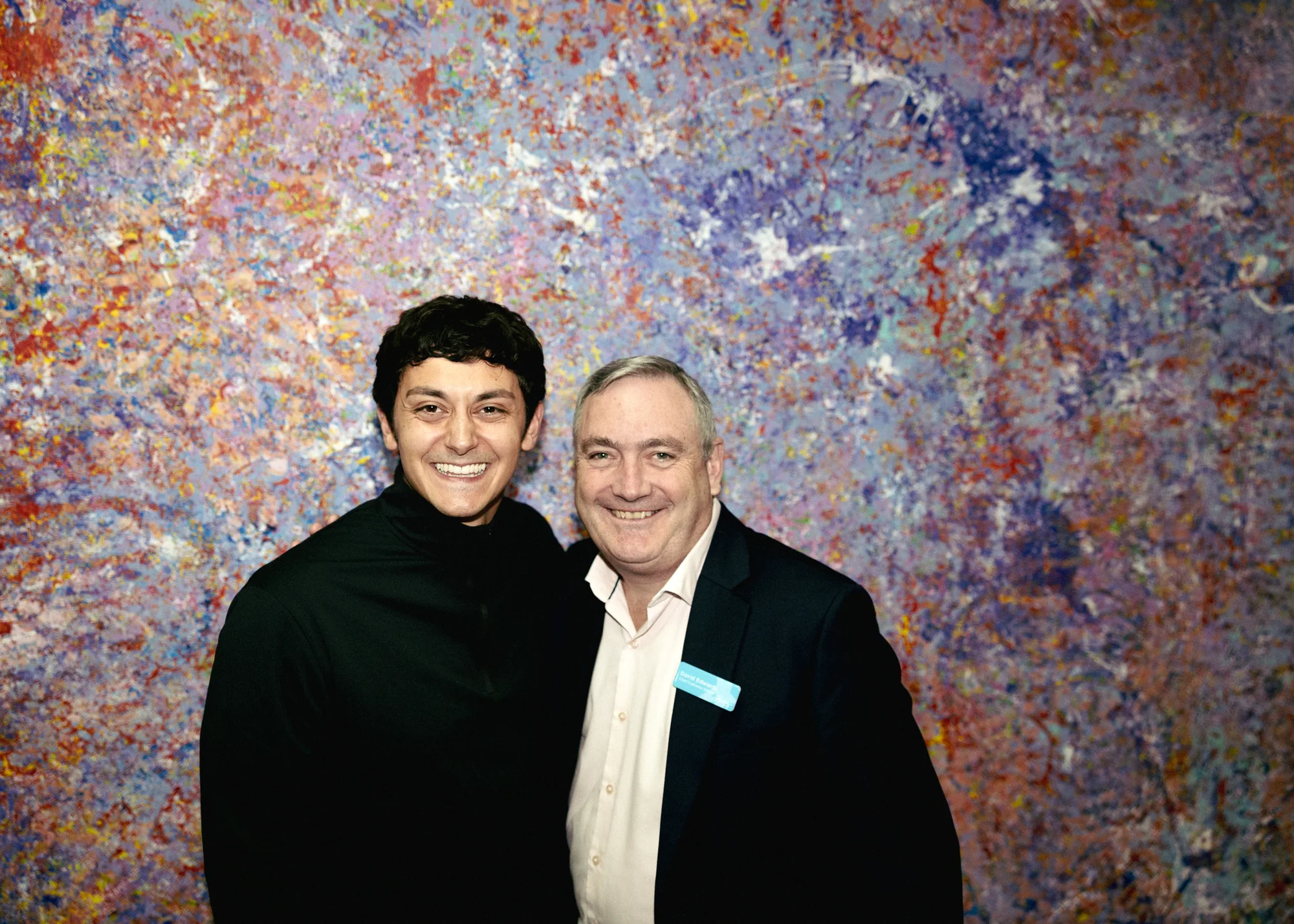
This profile first appeared in the Fall 2026 edition of Lifestyles Magazine (US and Canada). Written by Robin Smythe. Photography by Penny Lane.
On paper, artificial intelligence is supposed to change everything. It will transform industries, reinvent productivity, and reshape the future of work.
But when you sit down with Keoki Alexander-Chang, that's not really what he wants to discuss.
Instead, he talks about paperwork. The forms. The reports. The compliance documentation. The endless administrative tasks that consume hours of a care worker's day.
It's not the sort of problem that usually captures headlines. Yet for Alexander-Chang, the founder and CEO of Minikai, it may be one of the most important problems AI can solve. Because every hour spent on paperwork is an hour not spent helping someone. And in disability services, aged care, and community health, those hours add up fast.
Inspiration for a new era
For Alexander-Chang, Minikai began long before the company itself. It began at home.
Supporting his mother navigate the realities of health and social services gave him a perspective that many tech founders never experience. He saw how difficult it could be to access support, how fragmented systems created barriers, and how much time professionals spend managing paperwork rather than helping people.
Those experiences stayed with him as he built a career in artificial intelligence. While many AI entrepreneurs were focused on consumer apps or enterprise productivity tools, Alexander-Chang kept returning to a more personal question: What would happen if this technology could help families like his own?
“Ky Shera-Jones, our co-founder and CTO, is an old friend of mine,” Alexander-Chang says. “From the moment we met in a university lecture years ago, we have been in a continuous debate about the potential benefits and risks AI could bring to the world. This debate is still going today, except now through our company, we can help realize the benefits by solving a problem that has had a direct impact on our families.”
The result was Minikai, a company built not around the idea of replacing care workers, but around helping them spend less time on administration and more time with people.
The invisible crisis
Most people understand that health care systems are under pressure. They know about staffing shortages. They know about funding challenges.
What they don't see is the administrative burden that sits behind every interaction. Support workers document visits. Care coordinators prepare reports. Clinicians spend hours completing compliance requirements.
Alexander-Chang believes too many systems have become focused on process instead of people.
“Individuals with lived experience should be at the center of the conversation about how to improve systems that are designed to support them and their loved ones,” he remarks.
Then he offers a critique that cuts to the heart of how many care systems operate today: “I am generally skeptical of processes designed to prevent rule breaking because they generally cause people to start working for the process rather than the process working for people.”
For him, paperwork isn't merely an inconvenience. It's a symptom of systems that have drifted away from the people they were built to serve.
Building an AI teammate
When Minikai launched, its mission was remarkably focused. Not replacing care workers. Not automating human relationships. Not creating artificial caregivers.
Instead, the company set out to build tools that reduce administrative burden while preserving human judgment and oversight. That distinction matters deeply to Alexander-Chang.
“Minikai provides relevant context based on a patient's history but does not replace the professional's judgment when deciding what is best for the patient's care,” he says. “Decision making and accountability need to remain with people.”
In a technology industry obsessed with automation, it's a surprisingly restrained philosophy. But health care is different. Trust matters. Evidence matters. And accountability matters. That's why Minikai's products are designed to show users exactly where information comes from.
“In a complex health context, evidence is crucial so people can apply reasonable judgment and objectivity in their decision making,” he says.
Designing for trust
One of the more interesting aspects of Alexander-Chang's thinking is that he doesn't believe good technology should always remove friction. Sometimes, he notes, friction serves a purpose. He points to documentation in clinical environments.
“An example of adding ‘good friction’ is assisting a clinician with documentation,” he says. “An AI system should not follow a user's instructions blindly, but should prompt them for more context to support better continuity of care.”
The details are important.
“This provides a small amount of friction and delegates responsibility to the user to make sure all facts are explicitly documented by a human, rather than relying on AI to generate documentation for them,” Alexander-Chang adds.
It's a philosophy that runs counter to much of Silicon Valley's obsession with convenience. For Alexander-Chang, reducing effort and reducing responsibility are not the same thing.
Rethinking software
Behind Minikai is a larger belief about where technology is heading. Alexander-Chang sees AI as more than another software category. He believes it fundamentally changes how organizations work.
“There is no good reason to assume any traditional software is as valuable today as it once was,” he says. “AI can collapse a stack of disconnected applications into a single, context-aware system. This is a radically more efficient way of allowing information to flow through an organization.”
Ultimately, he says, efficiency isn't about software. It's about information. The more quickly information flows through a company, the more efficient it is.
Staying close to the front line
Despite Minikai's growth, Alexander-Chang is determined to keep the company grounded in the realities of care work. Every employee spends time observing frontline operations. It's not optional. Every person who joins Minikai's team spends time at the coalface, regardless of their role.
“Understanding what happens on a daily basis when frontline workers are supporting the world's most vulnerable people is critical to building a system that can truly support them,” he remarks.
Alexander-Chang believes empathy is not a soft skill but an operational requirement.
“This empathy is embedded in everything we do,” he says, smiling.
A bigger vision
Ask Alexander-Chang what success looks like, and he doesn't talk about revenue. He talks about advocacy. His vision for Minikai extends far beyond documentation and workflow automation.
“We will have truly succeeded when every person in disability and aged care has their own Mini: an AI advocate that advocates for the person's better quality of life, making sure the person can draw on the care and support they're entitled to,” he says thoughtfully.
It's an ambitious goal, but his ultimate measure of success is even broader.
“We will have succeeded when social care globally is financially sustainable so our loved ones can continue to live with dignity and respect,” he says.
The human thread
For all the discussion about AI, software, and systems, Alexander-Chang ultimately returns to people. The mentors who helped him. The family experiences that shaped him. The frontline workers who inspired the company. The vulnerable people the system is meant to serve.
And perhaps that's why Minikai feels different from many AI start-ups. Its story isn't fundamentally about technology. It's about responsibility.
As Alexander-Chang puts it: “Anyone with success is in their position because others went out of their way to help them.”
He sees that not as an observation, but as an obligation.
“This is why we all have a responsibility to help those around us,” he says.
For all the excitement surrounding AI, Alexander-Chang's vision for the technology is remarkably human: supporting people rather than replacing them. As Minikai continues to succeed, its greatest achievement won't be the software it built or the funding it raised. It will be measured in something more meaningful: time returned to people, dignity preserved, and a care system that is more connected to support those who need it most.